Archives for September 2012

Make Your Own Treadle Lathe

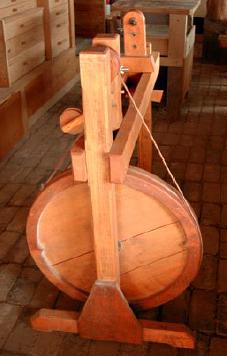
make your own treadle latheIn the last twenty years or so since I built this foot-powered treadle lathe, I have received many requests for drawings or plans.

The lathe has been used as part of our traditional woodworking demonstrations and it never fails to draw a crowd. Of course, the reason the lathe exists is because I felt a need for it as a tool.

Some of the main considerations when designing the lathe were:

  • Human powered — our solar energy system was pretty small at the time
  • Size — it had to be less than 42″ tall to fit into our old truck
  • Compact — since it would sit in our small shop all the time, a small footprint was essential
  • Portable — as in not too cumbersome or heavy
  • Functional — it had to perform the basic duties of a light-duty lathe
  • Adaptable — I had in mind several untraditional uses for the tool, like sanding”
Find the manual here.

More do-it-yourself projects.

How to make everything ourselves: open modular hardware.

Climbing Tall Stacks with the Aid of Kites

climbing tall stacks with the air of kites

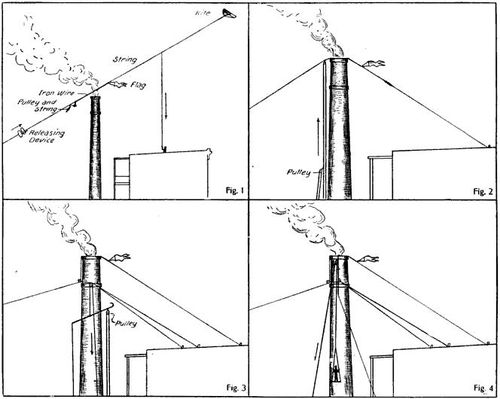
“Having occasion to make emergency repairs to the large 170-ft. chimney of the Consumers’ Ice Company, Chicago, and finding that the cost of erecting a scaffold ran up into hundreds of dollars and would take too much time, I decided to use one of my cellular kites for the purpose of hoisting and attaching a suitable block and tackle.”

Read more: Climbing Tall Stacks with the Aid of Kites. Popular Mechanics, November 1906

Pedal Powered Electronic Waste Recycling Machine

Bicyclean recycling electronic waste“The bicyclean is a safe, affordable, and efficient alternative for
harvesting electronic waste in developing regions. The bicyclean is a modified bicycle, where a processing chamber replaces the rear wheel and an external steel frame supports the rear hub. Processing of the circuit boards occurs within the sealed chamber and the particles are removed in a covered tray. A feed tube presses circuit board pieces into a large grinding wheel and become pulverized.”

“The particles pass a magnet that extracts ferrous metal particles. The particles then flow over a small eddy current rotor, which is positioned underneath the grinding wheel and powered by a 3:1 gear ratio with the bicycle chain. The changing magnetic fields of the eddy current rotor repulse conducting metal, but have no effect on non-metals; the metal particles are projected horizontally while the nonmetals fall vertically, separating particles in the bottom collection tray. The bicyclean requires a single operator.”

Read more: Bicyclean. Via Co.EXIST.