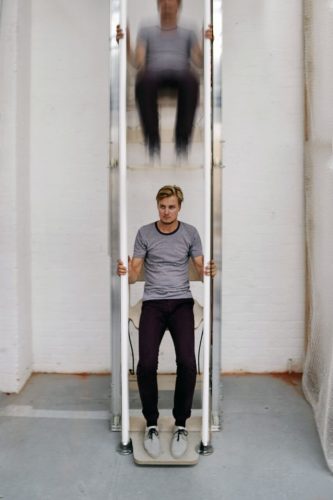
 “Even as our cities get more crowded and its buildings get taller, it seems that we have yet to find a more energy efficient way to navigate this high-rise environment. Right now, our options are limited to stairs, escalators, and elevators—all of which are expensive, require constant maintenance, and take up a lot of space.
Enter Rombout Labs and their concept of “vertical walking.” Their technology is designed to allow humans to move between building floors without the need for any sort of power supply, also using less effort than we would if we were using stairs, and making optimal use of available vertical space.
“By using harmonious movements and smart materials, only 10% of the effort of walking stairs is needed to bridge multiple floors. This not only provides a solution for the growing number of people who are unable to take stairs, but moreover offers new possibilities for urban architecture,” they explain on the Dutch Design Week website, where the system is currently featured.”
See & read more: New Futuristic Prototype Replaces Stairs and Elevators for ‘Vertical Walking’.