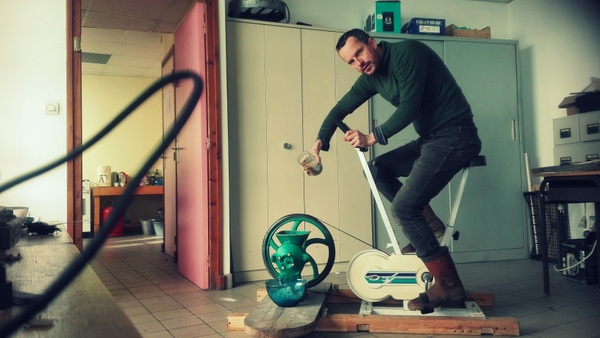
The Cyclocarder by Fibershed-contributor Katharina Jolda is a wonderful update to the article on pedal powered machines. The Cyclocarder can turn your backyard, community center, or farm into a human powered wool processing station.
Posted on February 09, 2012 in Human power, Pedal power | Permalink
What happens when two industrial design students from Sweden end up in Kenya creating a pedal powered machine for small-scale farmers who are often illiterate and speak more than 60 languages? You get a do-it-yourself design that seems to have come out of the IKEA factories - pictoral manuals included.
"Made in Kenya", the bachelor project of Niklas Kull and Gabriella Rubin, is a textbook example of low-tech made accessible to everybody, regardless of their native tongue and language skills.
Posted on November 13, 2011 in Access to information, DIY, Human power, Language, Pedal power | Permalink | Comments (4)
"Barge haulers on the Volga", a late 19th century painting by Ilja Repin.
Posted on October 07, 2011 in Barge haulers, Boats, Cargo, Human power, Paintings, Shipping | Permalink
"Harvesting energy from the users’ muscular power to convert this into electricity is a relatively unknown way to power consumer products. It nevertheless offers surprising opportunities for product designers; human-powered products function independently from regular power infrastructure, are convenient and can be environmentally and economically beneficial."
"This work provides insight into the knowledge required to design human-powered energy systems in consumer products from a scientific perspective. It shows the developments of human-powered products from the first introduction of the BayGen Freeplay radio in 1995 till current products and provides an overview and analysis of 211 human-powered products currently on the market."
"Although human power is generally perceived as beneficial for the environment, this thesis shows that achieving environmental benefit is only feasible when the environmental impact of additional materials in the energy conversion system is well balanced with the energy demands of the products functionality."
"Human Power Empirically Explored" (PDF, 12MB), Arjen Jansen, 2011.
Posted on May 30, 2011 in Human power | Permalink
Posted on May 30, 2011 in Bicycles, Bikes, Human power, Pedal power | Permalink
Hand powered apple peelers can peel, core and cut apples with amazing speed and precision. They were available in a surprisingly large variety.
The 18th and 19th century saw a growing need for apples as a winter staple for both food and drink. Apples needed to be processed for winter storage. Paring, coring, and cutting enough apples for winter was difficult and time consuming.
Farmers used their creative skills to make wooden machines that made the process quick and efficient. Industrialization and the use of iron during the 19th century witnessed an explosion of patented creativity. More than 100 patents were granted from 1850 to 1890. Apple peelers were also used as a kitchen device.
There is a full website dedicated to hand powered apple peelers, explaining in detail the use, history and workings of the devices and showing many pictures and videos.
Posted on May 10, 2011 in Hand tools, Human power, Obsolete technology | Permalink
"The easiest way to utilize pump vacuums (picture below, left) was to have two people operate them. One person would pump the vacuum while a second would use the hose and wand or tools to clean. A common sight was a daughter pumping the handle while mom did the cleaning. Most early vacuum cleaners were expensive for the time. The well-to-do often would purchase the cleaning contraptions to ease the workload of their servants or housekeepers."
"Bellows operated vacuums appeared in several styles and shapes. Some early vacuums utilized a single bellows. This made the cleaner less efficient because there was no suction as the bellows closed. Suction was produced only as air rushed into the bellows as it opened. To make the machines more useful, bellows were installed in pairs and offset to allow one to open while the other closed." Picture right: a bellow-operated Star Vacuum Cleaner.
"In their day, wheel operated vacuums approached the cutting edge of early technology. They exhibited a sophistication that was not present in earlier vacuum designs. This style of machine provided powerful and continuous suction for its user. The increase in vacuum even allowed for larger diameter hoses and bigger cleaning tools. Typically, one person cranked the wheel while another cleaned with a wand or hand tool."
"Friction vacuum cleaners are based on an ingenious concept conceived by James Kirby. They utilize the driving force of the rear wheels to power the cleaner. This style of vacuum derives its power when the operator pushes it across the floor. The wheels contact the floor and turn the axle. This energy is transferred to the fan via a worm gear during every forward motion of the machine. The front wheels are connected to a brush roller to create a sweeping action. These machines look like an early electric upright vacuum, but do not need electrical current to run. As a result, they have no electric motor, cord, plug, or switch. This makes them lightweight, quiet, and cost free to use. Friction vacuums were popular well into the 1940's in communities where electricity was not available."
More: VacHunter galleries. Thank you, Adriana.
Posted on February 21, 2011 in Human power, Obsolete technology, Vacuum cleaners | Permalink
"Originally designed to serve the load carrying requirements of the Tri-Sled factory, the FlatBed Truck is a high-bulk load carrier. We use one of these for getting around our local industrial estate, transporting frames and fairings to our powder-coating and painting contractors, or picking up steel and other oversized materials."
"The FlatBed Truck is far more convenient than carting large items to and from a car or van. With this maneuverable vehicle, you can simple roll straight in and out of your business or factory. It even serves as a handy rolling work bench for working outside on sunny days."
"The FlatBed Truck is also incredibly easy to store. Just flip it up on its end when not in use, and use the rear rolling wheels to move it against a wall or into a small space. The rolling wheels also serve as a back bump stop." Trisled FlatBed Truck.
Posted on October 30, 2010 in Bicycles, Bikes, Cargo, Human power, Low-tech solutions, Pedal power, Quadricycles | Permalink
The Hase Klimax has won the Eurobike 2010 award. The Klimax is a recumbent trike with a foldable fairing and electric assist. Beats any electric city car in terms of efficiency.
Posted on September 09, 2010 in Bicycles, Bikes, Human power, Low-tech cars, Pedal power, Recumbent tricycles, Tricycles, Trikes | Permalink
Pterosail Trike Systems is sailing and cycling over 3,000 miles from coast to coast across the USA this summer. The Pterosail is a street-legal recumbent tricycle with sails. It can reach up to 40 mph in good winds. No wind? Pedal. See also: the Whike, a Dutch made sail assisted trike. Related: Guido Vigevano's wind car / Sailing rockets / Kiteboating / Velomobiles.
Posted on July 19, 2010 in Bicycles, Bikes, Human power, Pedal power, Recumbent tricycles, Tricycles, Trikes, Wind powered vehicles | Permalink
Posted on May 12, 2010 in Bicycles, Bikes, Human power, Pedal power, Recumbent tricycles, Tricycles, Trikes | Permalink
I wrote about prison treadmills before. They were invented in England in 1817
by Sir William Cubit, who observed prisoners lying around in idleness
and put himself to the task of "reforming offenders by teaching them
habits of industry".
Forty-four prisons in England adopted it as a form of
hard labour that could also grind grain or pump water.
However, as it turns out, in at least one jail prisoners were only "grinding the wind": they were walking a treadwheel that was connected to a giant fan built on the courtyard. By this apparatus the resistance necessary for rendering the
tread-wheel hard labour was obtained.
The system is explained in "The criminal prisons of London and scenes of Prison Life" (1862), written by Henry Mayhew & John Binny. Starting on page 299, they describe the method of "hard labour", and the technologies used for it: the treadwheel, crank labour & the shot drill. Great reading.
Posted on March 25, 2010 in History, Human power, Jailhouse technology, Treadwheels & treadmills | Permalink
Click on the illustration below to see the plan in high resolution. Source: "Mémoires et compte rendu des traveaux de la société des ingénieurs civils, Vol.12, 1859".
Posted on August 31, 2009 in Boats, Civil engineering, Human power | Permalink
The prison treadmill was invented in England in 1817 by Sir William Cubit, who observed prisoners lying around in idleness and put himself to the task of "reforming offenders by teaching them habits of industry." Forty-four prisons in England adopted it as a form of hard labour that could also grind grain (although some treadwheels were only "grinding the wind").
The punitive treadmill was then implemented in America for two long years, between 1822 and 1824, at Bellevue penitentiary outside New York. Prisoners stepped on the mill for 10 hours a day (with 20 minute breaks per hour), grinding grain, often with a large audience of jeering onlookers housed in a specially built viewing house. Read here and here. Picture credit. See more images.
Related: Human powered cranes and lifting devices.
Posted on May 11, 2009 in History, Human power, Jailhouse technology, Treadwheels & treadmills | Permalink
Maybe artists and fantasy are a better foothold for the future than engineers and high-tech. The pedal powered Hennepin Crawler is capable of both street and railroad track cruising and can seat four people. It is comprised of approximately 90% recycled materials and has a sex appeal that can rival that of a Porsche or a Land Rover. Via Make 17. Related: Cycle Chics. More on railcars. More low-tech cars.
Posted on April 13, 2009 in Bikes, Human power, Low-tech cars, Pedal power, Steampunk | Permalink