"Hi everybody my name is Chris. I choose my woodworking projects based on whatever happens to inspire me".
In this video, Chris builds a foot powered treadle lathe. Great project, great video.
Via Old Engineering.
Posted on April 22, 2013 in Craftsmanship, DIY, Lathes, Video, Wood, Woodworking | Permalink
Artist and maker Tim Hunkin repairs Victorian watches. On the picture: a 1908 Waltham pocket watch, Tim Hunkin.
Posted on April 22, 2013 in Craftsmanship | Permalink
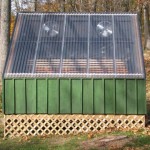
"Lumber is usually dried to a specific moisture content prior to further manufacturing or use. While lumber can be air-dried, the humidity in most localities prevents the lumber from reaching the moisture content required for the stability needed for interior use. The kiln discussed is designed to be inexpensive to construct and be simple to operate."
"The solar kiln described was designed, constructed, and tested at
Virginia Tech. This design is based on 25 years of research and
development on the solar drying of lumber in the United States and
foreign countries. Drawings for two versions of this kiln are available;
one for 800-1,000 bd ft and the other for 1,500-2,000 board feet of
lumber. Both kilns will dry a load of lumber in approximately one month
of moderately sunny weather at its location in Blacksburg, VA."
"Drying lumber can be a complex process where accelerating drying without having quality loss often requires extensive knowledge and experience. The design of the Virginia Tech solar kiln is such that extensive knowledge, experience and control are not required. The size of the collector keeps the kiln from over-heating and causing checking and splitting of the wood. The kiln is simple to construct and utilizes a passive solar collector, four insulated walls and an insulated floor. The roof is made of clear, greenhouse rated, corrugated polyethylene."
The Table Top Wool Wagon is among the largest animal-drawn road vehicles ever built. It was a unique Australian invention, built to transport wool from sheep farms to train stations and harbours.
As many as forty bullocks, or thirty horses, pulled the vehicles over distances of up to 1600 km.
Table Top Wool Wagons (also known as "jinkers" or "ships of the desert") appeared at the end of the nineteenth century and remained in use until the 1920s, when they were replaced by trucks.
Continue reading "The Limits of Animal Powered Transport: Table Top Wool Wagons" »
Posted on April 11, 2013 in Animal power | Permalink
The rolling friction of the tyres is the main resistance acting on a bicycle at speeds below 10 km/h (6 mph). At higher speeds, air resistance becomes far more important. It accounts for more than 80 percent of the total force acting to slow the vehicle at a speed of 35 km/h (22 mph). At this speed, it would take a power output of 345 watts just to overcome air drag when riding an upright commuting bike (on a level road in calm conditions). Riding a velomobile (a recumbent cycle with a fairing) can lower air resistance dramatically, reducing power to overcome drag to about 30 watts at a speed of 35 km/h.
However, velomobiles are expensive. A much cheaper option is the use of a partial fairing. These wind screens, made of shatter resistant polycarbonate plastic, are mounted at the handlebars. A partial fairing is placed so that the rider is able to see over it, not through it. Apart from reducing air resistance, it is also an effective shield against bugs, rain, cold air, and road debris.
Partial fairings are available for different types of upright bicycles, and for recumbents. They weigh between 600 grams and 1.5 kg, depending on the model, including mounts. These accessoiries, which can often be seen on motorcycles, are relatively unknown to cyclists, mainly because they are outlawed in conventional bicycle racing.
When used in combination with a road bike in touring position (with the hands on the handlebar), a partial fairing brings the power required to overcome air resistance at 35 km/h down to 157 watts. This compares to 220 watts for an unfaired road bike in touring position, and to 176 watts for an unfaired road bike in (a much less comfortable) crouched position and wearing tight clothing. A partial fairing on a road bike thus offers a similar advantage to that of an unfaired recumbent (148 watts). With a headwind, the advantage of improved aerodynamics becomes even larger. One disadvantage of fairings is their sensitivity for crosswinds gusts. It takes some practice to get used to them.
The numbers above were taken from "Bicycling Science" (third edition), by David Gordon Wilson, pp 188. The result for the partial fairing concerns an older model, so it might be an underestimation. Picture: a small partial fairing by Zzipper.
Posted on April 03, 2013 in Bicycles, Bikes, Pedal power | Permalink
"Forget batteries with complex chemistries or precision-tuned flywheels. A growing number of energy storage start-ups are promoting the idea that the most economical, most expedient ways to store power revolve around harnessing the four elements of the ancient world: earth, air, water and fire."
Read more: The most important man in energy storage? Try Archimedes.
Posted on March 29, 2013 in Energy storage | Permalink
"It is authoritatively stated that the building and maintenance of the farm fences in the United States have
cost more than the construction of the farm buildings.
Be this as it may, while large numbers of works have been written upon rural architecture we believe this is
the first publication specially devoted to Fences, Gates
and Bridges.
It aims to be a practical work, showing the "evolution" of the fence from the road barrier of logs, brush or sods to the latest improved forms of barbed wire. The numerous illustrations are mainly representations of fences, gates, etc., in actual use. The chapter on fence law is necessarily condensed. The various judicial decisions upon the subject alone would fill a large volume. This little work, the first and only one of its character, is given to the public in the confident hope that it will prove specially useful to farmers and village residents."
"Fences, gates, and bridges; a practical manual", George A. Martin, 1892. Thanks to Rob McWilliam.
"Shelters, Shacks, and Shanties presents lively, step-by-step tutelage
on building all types of temporary and long-term accommodations from
both natural and man-made materials. Published in 1914, this practical
classic is as essential a guide for today’s modern homesteader as it was
at the turn of the twentieth century.
Included are instructions for dozens of worry-free shelters for you to chose from, including a sod house for the lawn, a treetop house, over-water camps, a bog ken, and much more. Satisfying the builder’s need for the creature comforts of home, it also provides tips on how to build hearths and chimneys, notched log ladders, and even how to rig a front door with a secret lock. Illustrated throughout with a bounty of helpful line drawings, Shelters, Shacks, and Shanties harkens back to the can-do spirit of the American frontier that still thrives today."
Shelters, Shacks, and Shanties; and how to build them", D.C. Beard, 1914 (Gutenberg free e-book). The description is from the 2008 edition (Amazon). Thanks to Thurston.
Posted on March 29, 2013 in Architecture, DIY | Permalink
Under good climatic conditions and using specific technology, the full moon can be a powerful source of light. Using technology inspired by solar energy concentrators, the "Full Moon Theatre" lights its performances using only moonlight. Moonbeams are collected, concentrated, and focused on stage. The original Full Moon Theatre was built in Southern France and their plan is to create twelve Full Moon Theatres worldwide.
"Our mattress is worn out. We need a new one, but I’ve been dreading buying a new one. I don’t like the waste of it all: The ignoble dragging of the old mattress to the curb. The prospect of sleeping on a brand new construct of toxic foam and fire retardants... In Greece, Italy and France mattresses are made by local craftsmen, and are stuffed with 100% wool. These mattresses basically last for life. When the wool gets compressed the mattress guys will empty it out, fluff it up, and re-stuff it, adding more wool if necessary." [1]
"The bed Mary bought was made by Signor Oldani, a Milanese bed-maker and
upholsterer. He made beds the Italian way, and the way we used to make
mattresses in England before the introduction of short-lived internally
sprung ones.
The beauty of the mattress is that when it needs a wash, the wool can be pulled out, stuffed, in batches, into pillow cases, put through the washing machine and after drying, carded back into fluffy pile before being returned to the mattress cover.
Every few years, it needs to be re-carded, as the wool slowly compacts, says Mary. In Italy during the summer, the mattress man, il cardatore, tours Italian homes, pulls out the wool from their mattresses, re-cards it, adds some more, as the process reduces the stuffing a bit, rebuttons and then sews the mattress cover back up again. Mary submitted her mattress to this process four times." [2]
"Totally by chance, I found two places in Paris that still make their own 100% wool mattresses by hand... It was ready two days later. They told me to come back in 10 years to have the mattress redone: they pick it up in the morning, take out the wool stuffing, clean and refluff it, put a new cover on it, and then deliver it back to you before bedtime." [3]
Read more: 1 / 2 / 3. Via Root Simple.
Posted on March 16, 2013 in Craftsmanship, Low-tech solutions, Trash, Wool | Permalink
"The reaction of most people when I tell them I’m a scythe teacher is the same: incredulity or amusement, or polite interest, usually overlaid onto a sense that this is something quaint and rather silly that doesn’t have much place in the modern world. After all, we have weed whackers and lawnmowers now, and they are noisier than scythes and have buttons and use electricity or petrol and therefore they must perform better, right? Now, I would say this of course, but no, it is not right. Certainly if you have a five-acre meadow and you want to cut the grass for hay or silage, you are going to get it done a lot quicker (though not necessarily more efficiently) with a tractor and cutter bar than you would with a scythe team, which is the way it was done before the 1950s. Down at the human scale, though, the scythe still reigns supreme."
"A growing number of people I teach, for example, are looking for an alternative to a brushcutter. A brushcutter is essentially a mechanical scythe. It is a great heavy piece of machinery that needs to be operated with both hands and requires its user to dress up like Darth Vader in order to swing it through the grass. It roars like a motorbike, belches out fumes, and requires a regular diet of fossil fuels. It hacks through the grass instead of slicing it cleanly like a scythe blade. It is more cumbersome, more dangerous, no faster, and far less pleasant to use than the tool it replaced. And yet you see it used everywhere: on motorway verges, in parks, even, for heaven’s sake, in nature reserves. It’s a horrible, clumsy, ugly, noisy, inefficient thing. So why do people use it, and why do they still laugh at the scythe?"
"To ask that question in those terms is to misunderstand what is going on. Brushcutters are not used instead of scythes because they are better; they are used because their use is conditioned by our attitudes toward technology. Performance is not really the point, and neither is efficiency. Religion is the point: the religion of complexity. The myth of progress manifested in tool form. Plastic is better than wood. Moving parts are better than fixed parts. Noisy things are better than quiet things. Complicated things are better than simple things. New things are better than old things. We all believe this, whether we like it or not. It’s how we were brought up."
Read more: "Dark Ecology, searching for truth in a post-green world", Paul Kingsnorth, Orion Magazine. Image source.
Posted on March 06, 2013 in Environmentalism, Quotes, Technology, Tools | Permalink
The major cost element in using the Nubian Vault method is labour, often provided by family members and neighbours on an exchange / barter / self-build basis, thus keeping cash in the local economy; the raw materials (earth, rocks, water) are locally available and ecologically sound; construction with mud bricks and mortar is traditional in the Sahel region - the innovation of vault construction can easily be incorporated into existing practice."
More information, including building guidelines and house plans, at "La Voûte Nubienne" (website in English and French).
Previously:
Posted on March 05, 2013 in Architecture | Permalink
"The Culticycle is a pedal powered tractor that can cultivate, seed, spray, or pull gear for most low horsepower tasks. Small tractors do many jobs very well and very fast, but also consume fuel, compact soil, cost a lot, and cause physical damage to the operator -– mainly spine and joint problems. Many of their jobs could be done, slower but better, by human pedal power.
This prototype consists of:
The materials are rebar, unistrut, landscape rake tines, and parts from bikes, an ATV, and a lawn tractor. It attempts to show that human pedal power can do some jobs of small tractors, albeit in twice the time, and that the design can be simple enough that no extra weight is needed for traction. The effort required is similar to climbing a 10 degree slope on a seventies Schwinn 3 speed. This prototype was built for testing: a more easily buildable version is in the works."
Found at Farmhack. This is begging for an open modular approach. Thanks to Tim Cooke.
Posted on February 13, 2013 in Farming, Pedal power, Pedal powered machines | Permalink
"According to Iroquois legend, corn, beans, and squash are three inseparable sisters who only grow and thrive together. This tradition of interplanting corn, beans and squash in the same mounds, widespread among Native American farming societies, is a sophisticated, sustainable system that provided long-term soil fertility and a healthy diet to generations."
"Corn provides a natural pole for bean vines to climb. Beans fix nitrogen on their roots, improving the overall fertility of the plot by providing nitrogen to the following years corn. Bean vines also help stabilize the corn plants, making them less vulnerable to blowing over in the wind. Shallow-rooted squash vines become a living mulch, shading emerging weeds and preventing soil moisture from evaporating, thereby improving the overall crops chances of survival in dry years. Spiny squash plants also help discourage predators from approaching the corn and beans. The large amount of crop residue from this planting combination can be incorporated back into the soil at the end of the season, to build up the organic matter and improve its structure." Read more: 1 / 2 / 3.
"Since the invention of aircraft, a similarity has been noticed between the operation of sails on boats and the function of wings of aircraft. Sails on boats provide thrust in a horizontal direction derived from moving air, and wings on aircraft provide 'lift' in a vertical direction to support a plane in the air, also from moving air (relative to the plane).
In order to fly, wings had to have a certain degree of efficiency, and some experimenters have realised now that aircraft-type wings could be used on a boat and would be more efficient than sails."
"Having tested wings on boats in place of sails ('wingsails') designers noticed another feature used on aircraft that would be useful to use in conjunction with wingsails – controlling the wingsail with another smaller surface mounted behind or in front of it (a 'tail'). There are many examples of tails used to control the direction of bodies both in the water and in the air, and aircraft use them to adjust, to a precise degree, the lift or (angle of attack) of their wings."
"If a tail is used attached to a boats’ wingsail, it can adjust the wing perfectly to every small change of wing direction, in this way relieving the sailor of this task, which is mostly guesswork and at best very approximate, and it can perform that job much better than any sailor can do. Such a wingsail/tail combination is referred to as a self-trimming wingsail."
Posted on February 01, 2013 in Sailing ships, Travel, Wind Power | Permalink
Posted on January 29, 2013 in Bicycles, Bikes, Pedal power, Travel | Permalink
"Out in the Bodie mining district, California, they have a peculiar motor in use. It is called an arastra, and consists of an overshot wheel operated by sand instead of water. A windmill runs a belt containing buckets, which carry the sand up to a big tank, just as grain elevators carry wheat in a flouring mill. A stream of sand is let out upon the overshot wheel and it revolves just as it would under the weight of a stream of water. The arastras move steadily at their work. When there is much wind, sand is stored up for use when calm weather prevails, so the arastras are never idle. It is perhaps needless to say that the sand is used because water is scarce. The arastra is an invention of a miner named Townsend."
Quoted from: The Manufacturer and Builder, Volume 0016 Issue 2 (February 1884).
Posted on January 27, 2013 in Energy storage, Water powered machines, Water wheels | Permalink