“Energy storage becomes more important as we transition away from fossil fuels—already its own energy storage medium—to more intermittent sources. But besides batteries—which offer a limited number of cycles and for some types require monthly maintenance—what other non-fossil in-home energy storage alternatives might we consider, and how much energy might we expect to store in each case? We will look at gravitational storage, flywheels, compressed air, and hydrogen fuel cells as possible options. Some might even cost less than $100,000 to implement in your home.” Read more.
Archives for September 2011
Trees as Indicators of Prevailing Wind Direction
September 9, 2011 by Filed Under: Random, Trees, Wind Power, Wind turbines, Windmills
 “In mountainous areas, winds are often complex and the available wind data are limited and provide little information on wind direction. One technique for determining the mean wind direction is tree flagging. Trees have been used for hundreds of years as an ecological indicator of wind direction, wind exposure and as a measure of the severity of wind and ice damage. This handbook will describe techniques for ‘reading’ the information written on the trees by wind.”
“Flagged trees only reflect the prevailing wind direction of the strongest winds, which may occur during only part of the year. Seasonal variations in the wind have a pronounced effect on the type of wind deformation and these effects are characterized in this handbook. Techniques for estimating the mean annual wind speed have been developed using indices of wind effects on trees. These indices have been calibrated on two widely distributed species of conifers. The main conclusions are that trees provide a simple, inexpensive and quick method for identifying promising locations where more detailed measurements can verify the wind potential.”
Trees as an indicator of wind power potential (.pdf), John E. Wade & E. Wendell Hewson, 1979.
Vegetation as an indicator of high wind velocity (.pdf), DOE report, John E. Wade & R.W. Baker, 1977
More low-tech wind power.
Making a Blade out of Homemade Steel
September 9, 2011 by Filed Under: DIY, Metal working, Random

“From Dust to Edge is the documentation of a long journey in the efforts of making a blade out of homemade steel. My interest in blades started with the legendary Japanese katana and as a result of wanting to learn more about how they were made I ended up becoming a bladesmith.
I combined the traditional Japanese techniques and the current knowledge of the Western smith in this pictorial representation. The project will be divided in several sections. It is primarily a visual description through photographs.”
Via Kevin Kelly.
Continuously Variable Bicycle Gear Hub
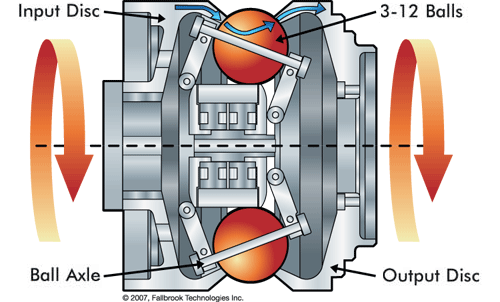 “The NuVinci hub is a unique internal gear hub in that it utilizes a continuously variable planetary (CVP) transmission. This means that the hub does not have specific gears but instead can be dialed in to any particular gearing in it’s capable range. You can think of it sort of as an analog radio tuner as opposed to a digital tuner with its particular increments.”
“When compared to traditional continuously variable transmissions (CVTs), the NuVinci CVP is less complex, has considerably fewer parts, offers more stable control and scalability across product lines, is better packaged, and is less expensive to manufacture and assemble.”
The NuVinci N360. How it works. Reviews of 2007 and 2010 models: 1 / 2 / 3. The gear is used on the flywheel bicycle mentioned last week and can also be applied in light electric vehicles and wind turbines. Thanks, Johan.