Archives for March 2014

The Atlas of Environmental Justice

atlas of environmental justice

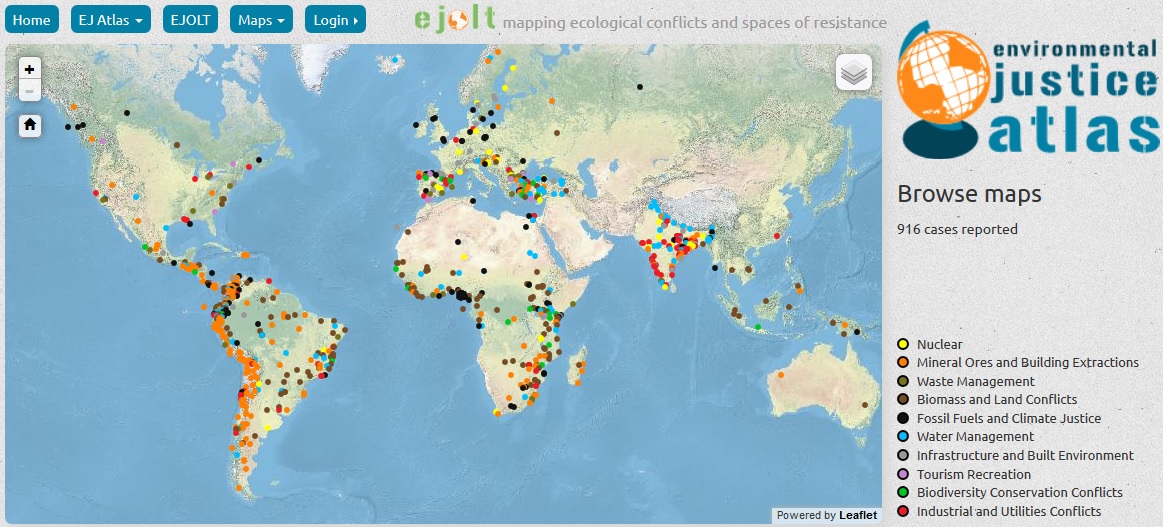
“Across the world communities are struggling to defend their livelihoods from damaging environmental impacts. Mining projects, mega dams, tree plantations, fracking, gas flaring, incinerators, etc … As resources needed to fuel our economy move through the commodity chain from extraction, processing and disposal, environmental impacts are externalized onto the most marginalized populations. But all this takes place far from the eyes of the consumers of the end-products. The Environmental Justic atlas aims to make these impacts more visible and to make the case for true corporate and state accountability for the injustices inflicted through their activities.”

“The map tells a story of environmental devastation and despoliation, of ecocide and eco-apartheid, but also a story of resistance, and communities mobilizing to fight against the odds. Of the cases currently in the map, 17% are successes for environmental justice. Court cases were won, communities were strengthened, and access to the commons was reclaimed. These victories are a testament to the power of protest and the ability to impact the political process. We don’t aim to “solve” the conflicts but to reveal the actors and drivers and structural patterns behind them. The defense of territory, the defense of livelihood and the defense of the resources that communities depend on are the best weapon against endless capitalist exploitation of the ecological system we depend on.”
The Atlas of Environmental Justice.

Adapting to Climate by Being a Nomad within your own House

While some people seasonally move between dwellings, others are nomads within their own houses. In such diverse places as Iraq, Algeria, and India, climates and cultures may vary, as do the directions and rhythms of movement. But all share migration within the dwelling as a primary mode of adaption to climate.

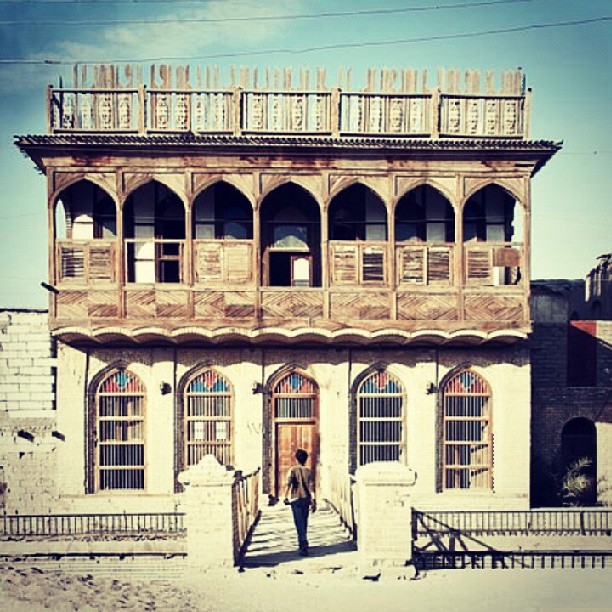
Families living in traditional courtyard houses of Baghdad, without mechanical ventilation or heating, migrate by day and season for comfort. In September or October, they move around the courtyard to rooms facing south. In April or May they shift to the north-facing rooms. In summer there is a daily vertical migration, the afternoon siesta being spent at the lowest levels and the nighttime sleep traditionally being taken on the roof under the stars.

old baghdad house

Picture: muhammadshnait91.tumblr.com

Such migrations mean that space is used with a freedom unusual in modern life and in the West. Recent correspondence from Mounjia Abdeltif-Benchaabane, a professor of architecture in Algiers, describes how rooms there have not traditionally been organized with regard to individual use or established purpose:

A living room becomes a sleeping room at night. Closets are full of mobile furnishings. In the morning everything is hung near windows to air out under the sun before being reused, perhaps in a different room. The kitchen is a multifunctional space. They cook on the floor even if they have modern tools.

A long-established Arab concern with privacy, in conjunction with the custom of migrating through the house, established the texture of some old cities like Baghdad. Since the roof is used for sleeping during nearly half of the year and the privacy of the family at night is fundamental, no house could look down upon its neighbor nor could one house look into the courtyard of another. The result was an effective building height control with advantages for solar access: no house could overshadow another, thus assuring wintertime light and heat to upper living spaces.

Quoted from “Ritual House: Drawing on Nature’s Rhythms for Architecture and Urban Design“, Ralph L. Knowles, 2006.

Crimean Ovens

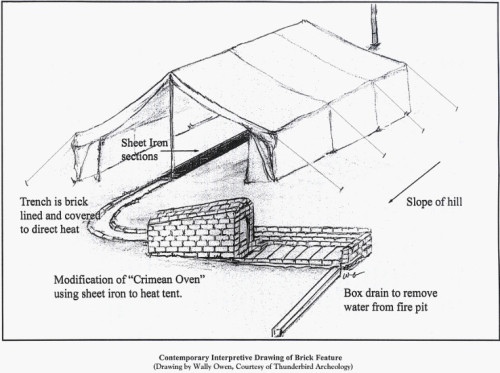
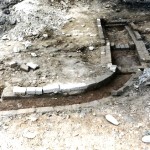
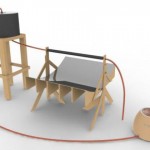
“Starting in 1861, the wintertime Union field tent hospitals of the U.S. Civil War often used subterranean heating systems known as Crimean Ovens. The system under discussion was basically a firebox, or oven, on the outside of the tent, with a shallow, brick-lined, sheet-metal-covered trough running down the center of the tent’s interior, and ending in a chimney on the opposite exterior side of the tent. The tents were placed on ground with slight inclines, allowing the hot air to naturally rise and escape out the flue.”

crimean oven

“Dr. Charles Tripler, Surgeon and Medical Director of the Army of the Potomac, writes in a letter of November 1861 the following description of “a modification of the Crimean Oven”, devised and put into operation by Surgeon McRuer, the surgeon of General Sedgewick’s Eighth Brigade:

A trench 1 foot wide and 20 inches deep to be dug through the center and length of each tent, to be continued for 3 or 4 feet farther, terminating at one end in a covered oven fire-place and at the other in a chimney. By this arrangement the fire-place and chimney are both on the outside of the tent; the fire-place is made about 2 feet wide and arching; its area gradually lessening until it terminates in a throat at the commencement of the straight trench. This part is covered with brick or stone, laid in mortar or cement; the long trench to be covered with sheet-iron in the same manner. The opposite end to the fire-place terminates in a chimney 6 or 8 feet high; the front of the fire-place to be fitted with a tight movable sheet-iron cover, in which an opening is to be made, with a sliding cover to act as a blower.

crimean oven 2By this contrivance a perfect draught may be obtained, and use more cold air admitted within the furnace than just sufficient to consume the wood and generate the amount of heat required, which not only radiates from the exposed surface of the iron plates, but is conducted throughout the ground floor of the tent so as to keep it both warm and dry, making a board floor entirely unnecessary, thereby avoiding the dampness and filth, which unavoidably accumulates in such places.

All noise, smoke, and dust, attendant upon building the fires within the tent are avoided; there are no currents of cold air, and the heat is so equally diffused, that no difference can be perceived between the temperature of each end or side of the tent.”

Read more: 1 / 2 / 3.