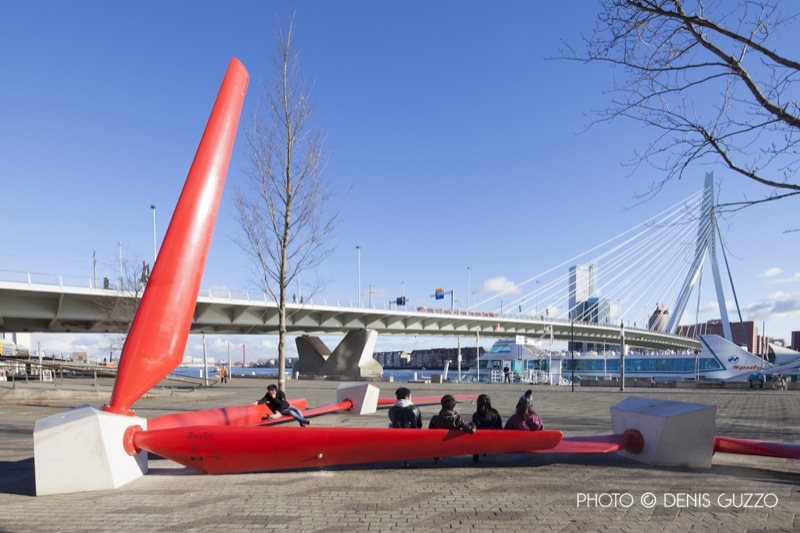
Almost a quarter of a million windmills worldwide will need to be replaced by 2030. The rotor blades are made of valuable composite materials that are difficult to recover at the end of their energy generating life. New generation rotor blades made of glass or carbon fibre composite material have average lifespans of between 10 and 25 years. Recycling of glass fibre composite is possible though complex. Recycling of the more highly valued carbon fibre composite is currently impossible. In many EU countries landfill of carbon composites is now prohibited. Thus, many rotor blades at the end of their wind turbine life are currently shredded and incinerated. At current growth rates, by 2034, there will be about 225,000 tonnes of rotor blade composite material produced annually, worldwide.
The Dutch firm Superuse Studios has found a solution to the growing mountains of waste generated by the wind industry: making use of end-of-life rotor blades in design and architecture. The realised projects demonstrate the technical applications and potential for blade made designs and architecture. In their second life as design and architectural elements, rotor blades could be used for a further 50-100 years, or more. Blade made designs are durable, iconic, compete economically, and reduce the ecological footprint of projects in which they are used. [Read more…]