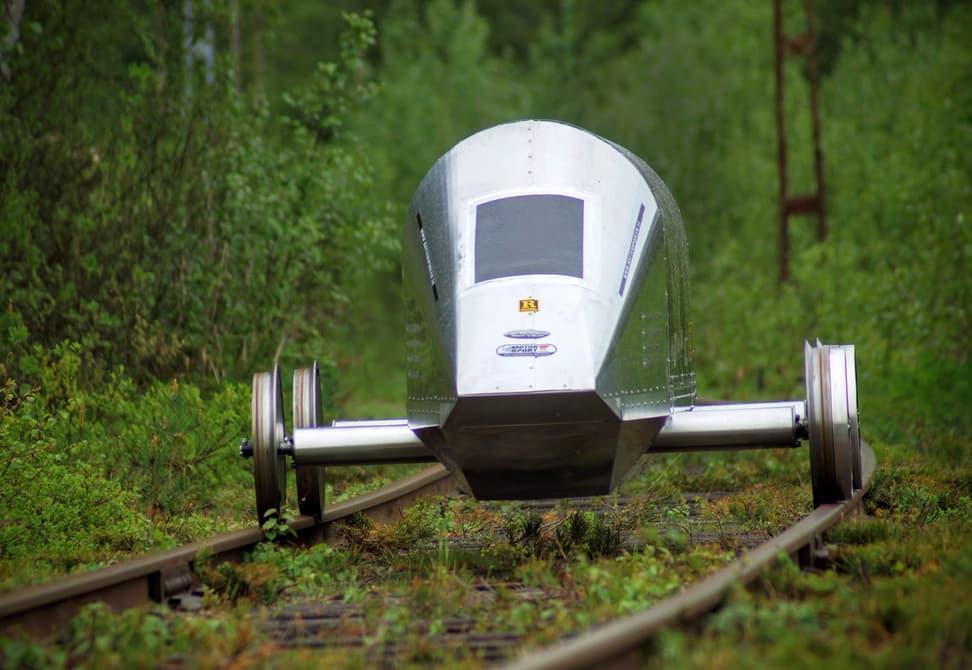
Students from Dalarna University, Sweden, have won a competition for creating efficient rail-based transport, claiming a world record in the process. Team Eximus 1 was competing in Delsbo Electric, where teams must design and build a battery-operated railway vehicle that uses as little energy as possible. Delsbo Electric is open to college and university students. It was inspired by the Shell Eco-marathon, with the concept translated for rail-based rather than road-based travel.
Vehicles must carry between one and six passengers weighing a minimum average of 50 kg (110 lb) each. Vehicle efficiency is measured on a per person basis, meaning vehicles carrying six passengers are not at a disadvantage. The Eximus 1 carries five passengers. The vehicle is estimated to weigh about 100 kg (220 lb) and to measure about 5,500-mm (217-in) long by 1,500-mm (59-in) wide. It was powered by four 12 V, 45 Wh batteries linked together in parallel and a 500 W motor.
The team’s final efficiency score was 0.84 Wh/person-km (watt-hours for every kilometer traveled by each passenger). Delsbo Electric claims that is a new world record. “We have done research and not found any information about somebody or something traveling as efficient rail-based in the world. In fact, it seems like Eximus 1 achieved a lower energy consumption per person than the current Shell Eco Marathon record.”
See & read more at Gizmag: Silver machine rolls down the track to new efficiency record. Vehicles from other participants can be found here. Thanks to Frank Van Gieson.
Related: