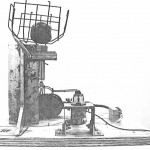
Instead of installing an expensive motor, former Princeton student Eden Full is making a simple part that expands with heat, automatically moving a panel to its most electricty-generating position: The SunSalutor.
Low-tech Bulbs for Dark Slums
Watch the video. Thank you, Joe Blogs and Lalon.
Build a Solar Powered (Interior) Kitchen
August 10, 2011 by Filed Under: Cooking stoves, DIY, Random, Solar
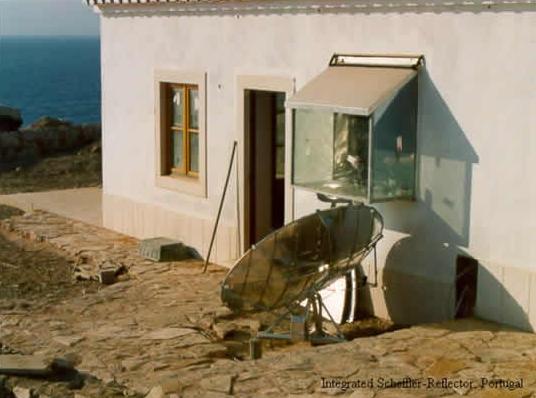
Solare Brücke is an organisation that promotes the distribution of solar thermal technology, both in developing countries and in the first world. They offer detailed construction manuals, which can all be downloaded for free.
One example is the Scheffler-Reflector (see the picture on the right): “To make cooking simple and comfortable the cooking-place should not have to be moved, even better: it should be inside the house and the concentrating reflector outside in the sun. The best solution was a eccentric, flexible parabolic reflector which rotates around an axis parallel to earth-axis, synchronous with the sun. Additionally the reflector is adjusted to the seasons by flexing it in a simple way.”
The Scheffler-Reflector can be built in steel or aluminium, and there are additional manuals available for the mechanical tracking system, a stove and a baking oven. There are also plans for a solar tunnel dryer and a smaller solar cooker. Find all manuals at Solare Brücke. Thanks to Eric Blair. Related: The bright future of solar powered factories.
Window Orientation and Shading
June 28, 2011 by Filed Under: Air conditioning, Architecture, Cooling, DIY, Random, Shading, Solar, Windows
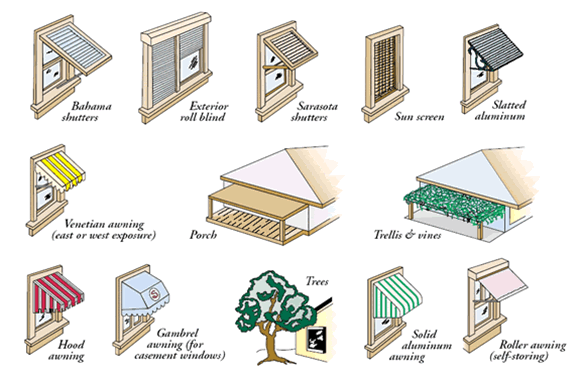
“In sunny southern locations, protecting your windows from the sun is an important component of good window management. The first step is to know how the sun moves through the sky and to orient the building and place the windows in it so as to minimize direct solar admission through your windows.” Read more.
“Sustainable By Design provides a suite of shareware design tools to calculate the right dimensions and placing for your specific location, wherever you are.
- SunAngle: our premier tool for solar angle calculations.
- SunPosition: calculates a time series of basic solar angle data.
- Sol Path: visualization of the path of the sun across the sky.
- Window Overhang Design: visualization of the shade provided by a window overhang at a given time.
- Window Overhang Annual Analysis: visualization of window overhang shading performance for an entire year.
- Overhang Recommendations: suggested climate-specific dimensions for south-facing window overhangs
- Light penetration: visualization of the penetration of sunlight into a room
- Louver Shading: visualization of louvered shading system performance for an entire year.
- Vertical Fin Shading: visualization of a vertical fin shading system performance for an entire year
- Window Heat Gain: calculation of monthly heat gain through windows.
- Panel Shading: visualization of the shading of rows of flat panel collectors throughout the year.”
Interesting follow-up at Treehugger.
Solar Heating System with Water Battery
May 30, 2011 by Filed Under: DIY, Heating appliances, Pools, Solar
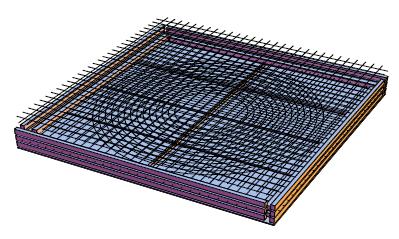
Dutch inventor Kees van der Geer sends us this paper and wants to know what we think of it. Comments are open.
“Heating with a sun collector costs nothing and contaminates nothing. In this article I propose a solar heating system consisting of a large solar collector, suitable for the heating of a house and a heat store, capable to bridge a week of cloudy weather. Both are made from simple materials.”
“Maybe a practical solution to make a heat store is to buy a inflatable swimming pool of 17m3 and construct an insulating box around it. ”
Large area solar heating system (pdf), Kees van der Geer, 2011. (Artículo en Español).
Solar Powered Laser Cutter
April 22, 2011 by Filed Under: Solar
“This project explores the potential of harnessing sunlight directly to produce objects. The Sun Cutter is a low-tech, low-energy version of a laser cutter. It uses pure sunlight, focused by a ball lens, to repeatedly cut programmed shapes in up to 0.4mm thick plywood as well as paper and card.”
More projects from the RCA Design products Department.